

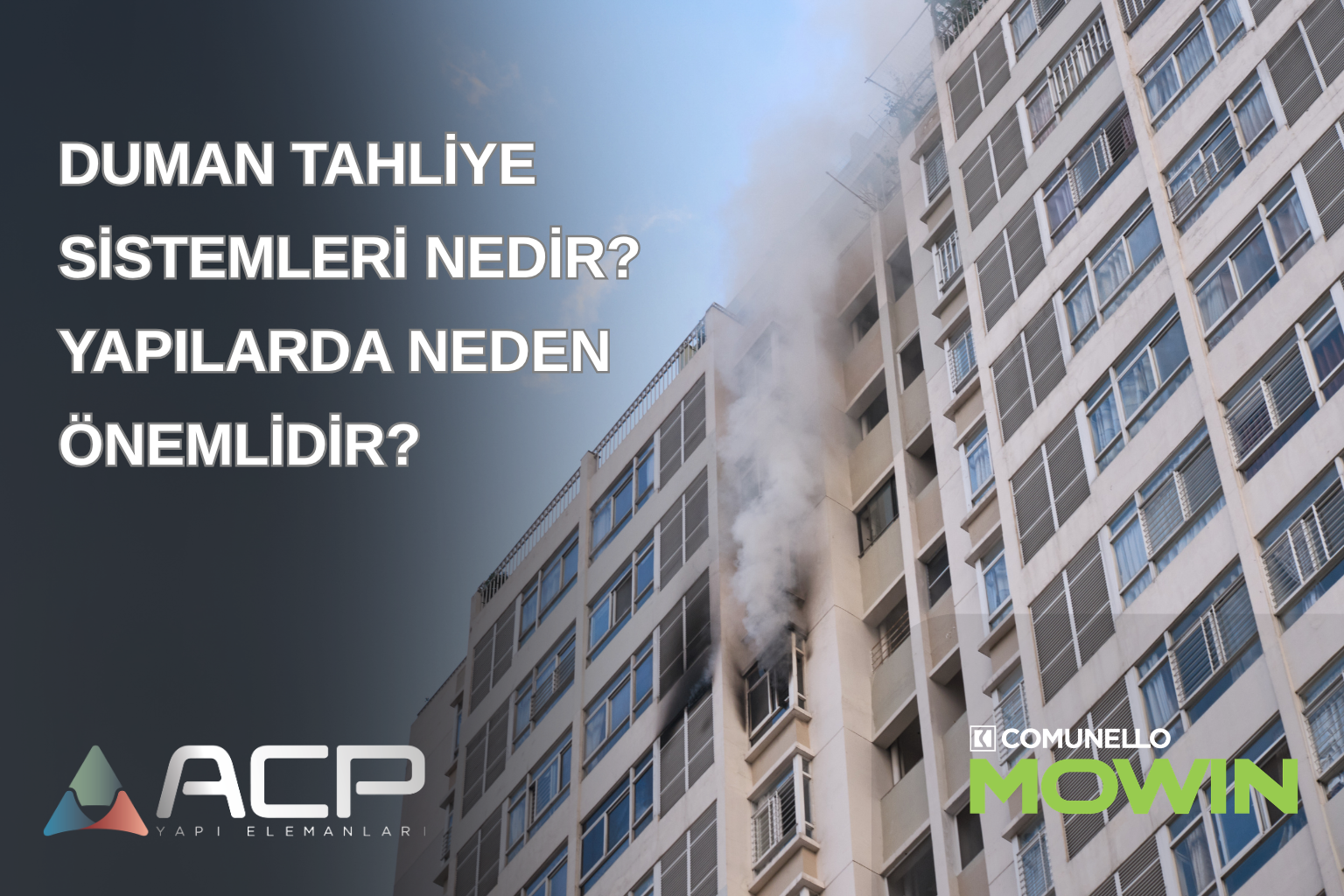
What are Smoke Evacuation Systems? Why is It Important in Structures?
The Importance of Smoke Control in Fire Safety
When it comes to fire safety, fire doors, fire-resistant walls, or extinguishing systems are often the first things that come to mind. However, one of the greatest risks during a fire is the rapid spread of smoke within the structure.
Smoke generated during a fire can reduce visibility, complicate evacuation processes and seriously affect the safety of people inside the structure. Therefore, fire safety in modern structures is not limited to merely containing the flames. Controlled smoke evacuation is also an important part of a comprehensive fire safety approach.
At this point, smoke evacuation systems play an important role in building safety scenarios.
What is a Smoke Evacuation System?
The smoke evacuation system is the general name for systems that help remove smoke generated during a fire from within a structure in a controlled manner.
These systems can be implemented using different methods according to the architectural and technical requirements of the project. Especially the roof windows, facade windows and natural ventilation openings can be opened automatically to direct the smoke out of the structure.
Smoke evacuation systems generally consist of the following components:
Automatic opening window systems
Chain-driven window motors
Piston window motors
Control panels
Control solutions that communicate with fire detection and alarm systems
Manual control and emergency buttons
Automation infrastructure suitable for the structure’s fire scenario
The design of the system should be determined based on the building’s intended use, architectural structure, evacuation scenario, and relevant project requirements.
Why Is Smoke Dangerous During a Fire?
The risk posed during a fire does not solely stem from the flames. Smoke can spread rapidly within a structure from the very first minutes of a fire.
The primary risks caused by smoke include the following:
Decreased Visibility
Thick smoke can make it difficult for people to see exit routes and directional signs. This situation can particularly adversely affect the evacuation process in large structures.
Escalation of the Evacuation Process
Smoke accumulating in corridors, stairwells, and common areas can adversely affect safe evacuation conditions.
**Smoke Propagation Within the Structure**
Uncontrolled smoke movement may cause areas outside the fire’s impact zone to be affected as well.
Therefore, in fire safety projects, the movement and evacuation of smoke should be considered as one of the key aspects of building safety.
The Role of Window Automation in Smoke Exhaust
Properly designed window automation systems can be among the important solutions that can be used in smoke evacuation scenarios.
Depending on the fire scenario, the automatic opening of designated windows can help remove smoke from the building in a controlled manner.
Automatic pop-up window solutions can be particularly preferred in the following areas:
Stairwells
Atriums
Corridors
Large common areas
Roof openings
Areas requiring overhead ventilation:
Industrial structures
Commercial structures
However, the needs of each structure are different. Therefore, the type of motor to be used, the size and weight of the window to be opened, the opening distance, and the control system must be determined according to the project requirements.
Difference Between Chain-Driven and Piston-Driven Window Motors
The type of motor to be used in window automation systems varies depending on the window’s structure and intended use.
Chain-Driven Window Motors
Chain-driven motors are among the preferred solutions, especially for different window types, thanks to their compact structure.
Its advantages include:
Compact design
Various opening distance options
Compatibility with various window types
Integrability into automation systems
Smart control options in some models
can be counted.
Piston Window Motors
Piston motors, on the other hand, offer solutions that can be preferred in applications requiring higher force or for heavy-duty window applications.
Specifically:
Large window systems
Heavy sashes
Applications requiring high force
Systems requiring wide-area coverage
can be designed with solutions tailored to project requirements.
Choosing the right motor should not be based solely on the motor’s power. The window’s dimensions, weight, opening mechanism, and usage scenario should be evaluated together.
In Which Structures Are Smoke Exhaust Systems Used?
The need for smoke control and evacuation may arise in many structures with different intended uses.
Hospitals
Hospitals are structures where security systems are of paramount importance due to their complex architectural designs and heavy human traffic. Solutions to be implemented in corridors, stairwells, and common areas should be evaluated in conjunction with the project’s overall fire safety scenario.
Hotels
In hotels with large numbers of guests, safe evacuation scenarios are an important element of building design. Appropriate solutions must be designed for common areas, corridors, and large-volume spaces.
Office and Commercial Buildings
In commercial buildings with heavy employee and visitor traffic, security scenarios within the structure must be planned together with architectural and mechanical systems.
Educational Buildings
In structures with high user density, such as schools and universities, safe evacuation planning is of paramount importance.
Shopping Malls and Large Public Buildings
Controlling smoke movement in structures with large enclosed spaces is an important part of overall fire safety planning.
Industrial Buildings
In manufacturing facilities and large-scale industrial structures, smoke evacuation solutions must be designed in accordance with the building characteristics.
Is Natural Ventilation the Same as Smoke Exhaust?
Natural ventilation and smoke evacuation are two different application areas where window automation systems can be used.
Natural ventilation can be achieved by controlling the opening of windows to support indoor air quality and user comfort.
Smoke evacuation, on the other hand, covers systems for the controlled guidance and removal of smoke inside the structure within the scope of fire scenarios.
Window engines can be used in both applications. However, the system’s purpose, control infrastructure, and project requirements may vary.
Therefore, it is important to accurately determine the purpose for which a window automation system will be used at the beginning of the project.
Why is Proper Product Selection Important in Smoke Exhaust Systems?
Not every window motor or automatic sliding window system may be suitable for every project.
When determining the correct solution, the following criteria should be evaluated:
Window dimensions
Sash weight
Opening type
Required opening distance
Motor’s pushing and pulling capacity
Frequency of use
Control system
General automation infrastructure of the structure
Fire scenario
Project and relevant regulatory requirements
Choosing the wrong product may cause the system to fail to deliver the expected performance, lead to problems during the implementation process, and result in additional costs.
Therefore, product selection should not be based solely on catalog information, but should be made in line with technical project evaluation.
Integrated Window Automation in Smart Buildings
Today, building technologies are not only focused on safety; they are also evolving to prioritize comfort, energy efficiency, and user experience.
Window automation systems can be used in different scenarios:
Daily natural ventilation
Time-controlled opening and closing
Sensor-based automation
Central control systems
Smart building applications
Security scenarios tailored to the building’s needs
Thanks to this approach, window automation within the same structure can be planned according to different usage needs.
Window Automation Solutions with ACP Building Elements
Window Automation Solutions with Comunello Window Motors
ACP Building Elements offers solutions for natural ventilation and window automation needs in buildings. In this context, Comunello window automation solutions of Italian origin offer chain and piston engine options suitable for different window types and project requirements.
Comunello window motors;
Solutions suitable for different window sizes and weights,
Chain and piston motor options,
Controlled window opening and closing,
Natural ventilation applications,
Chain motor solutions with intelligent control options,
Adaptation to different automation scenarios according to project requirements
With such advantages, it can be considered one of the important components of window automation in modern structures.
Smoke Control is an Important Part of Building Safety
Fire safety is not something that can be achieved with a single product or system. Many elements must be considered together, from fire doors to fire-resistant partitions, from alarm systems to evacuation solutions.
Smoke evacuation systems are also an important part of this whole.
Properly planned window automation and smoke control solutions can support security scenarios when evaluated in accordance with the intended use, architecture and project requirements of the structure.
You can contact the ACP Building Elements expert team to determine the right window automation and ventilation solutions for your building.
Email & Phone
info@acpyapi.com.tr
+90 (312) 348 68 68
+90 (533) 230 21 61