

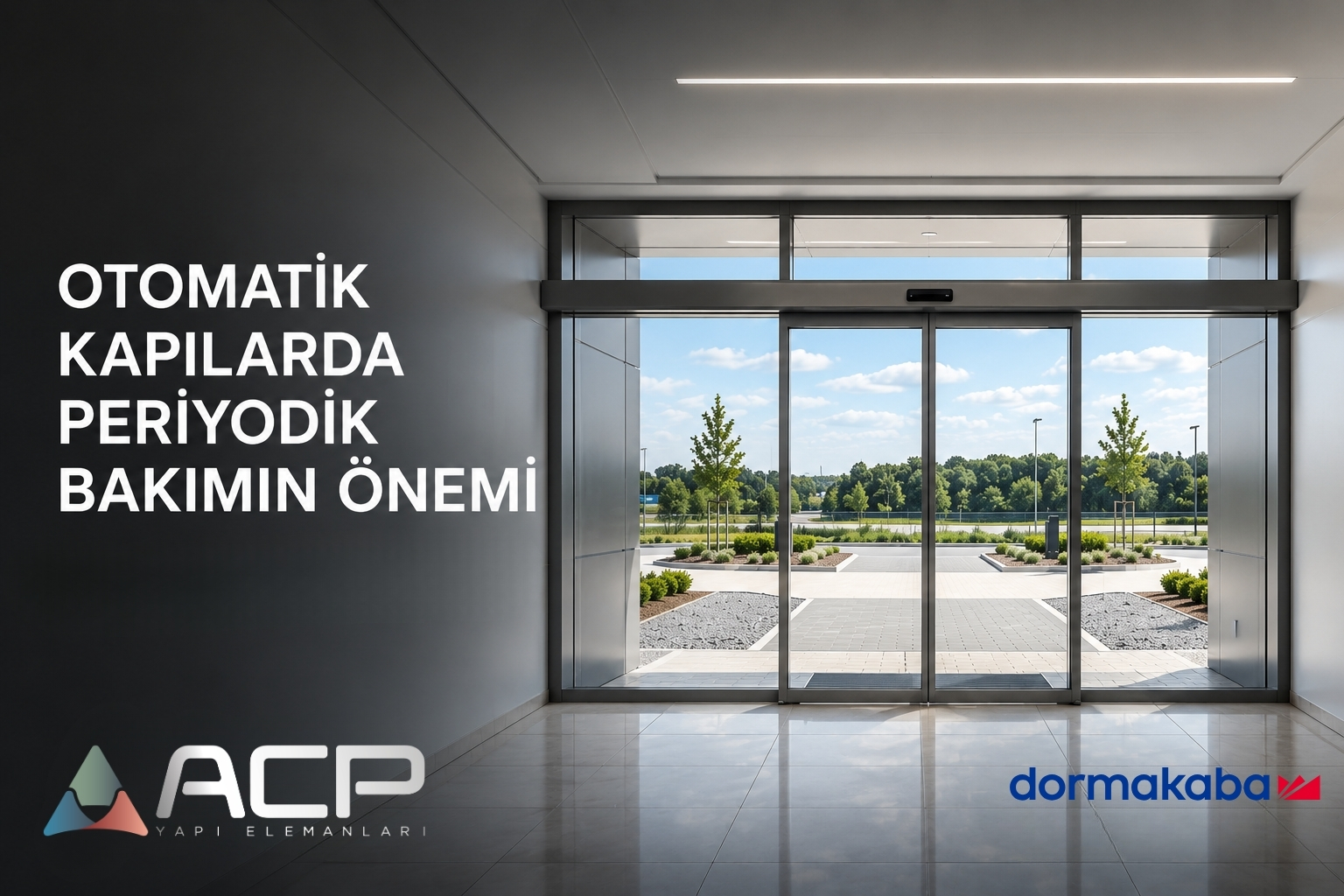
The Importance of Periodic Maintenance for Automatic Doors
Automatic doors in modern buildings are not only technological systems that facilitate entry and exit, but also an important building component in terms of security, accessibility, user comfort and continuity of building operations.
From hospitals to hotels, shopping malls to business centers, airports to public buildings, it is of great importance that automatic door systems work smoothly throughout the day in buildings that are heavily used. However, sustaining high performance is not only possible by choosing a quality product, but also through regular and proper maintenance practices.
So why is periodic maintenance important for automatic doors, and what problems can arise if maintenance is not performed?
What is Automatic Door Periodic Maintenance?
December maintenance of automatic door is the process of checking the motor, sensor, control unit, mechanical moving parts and safety equipment of the door at certain intervals, making the necessary settings and troubleshooting the detected problems.
During maintenance, simply checking whether the door opens and closes properly is not sufficient. The system’s safety, stability, quiet operation, and compliance with the manufacturer-specified operating conditions should also be evaluated.
Maintenance intervals may vary depending on door usage intensity, usage area, product type, and manufacturer recommendations.
Why is Periodic Maintenance Important?
It Supports Safe Transition
Automatic doors are constantly in motion in areas with heavy human traffic. Accurate sensor detection, controlled door movement, and proper functioning of safety functions are important for user safety.
Through periodic inspections, potential mechanical or electronic problems can be detected at an early stage.
Ensuring the continuity of safe passage is a critical issue, especially in heavily used structures such as hospitals, schools, shopping malls, hotels, and public buildings.
Helps Prevent Unexpected Malfunctions
The malfunction of an automatic door is not merely a technical problem.
Depending on the area where the door is located;
disruption of input-output operations,
formation of congestion,
slowdown of operational processes,
This may lead to consequences such as decreased user satisfaction,
the emergence of an urgent need for intervention
.
Regular maintenance helps detect wear and performance losses in the system early, thereby contributing to reducing the risk of unexpected failures.
Supports the Door’s Service Life
Automatic doors operate through the coordinated functioning of a motor, track, wheel, sensor, control unit, and various mechanical components.
As a result of heavy use, wear may occur on these components over time.
Through regular maintenance;
The condition of moving parts is checked,
necessary adjustments are made,
wearing components are identified,
The system’s operational performance is monitored.
This way, long-term, efficient use of a high-quality automatic door system can be supported.
It Contributes to the Control of Operating Costs
Although maintenance is often considered merely an expense item, it is an important part of cost management in the long term.
Failure to detect a minor mechanical problem in time may develop into a larger malfunction in the future. In such cases, not only part replacement costs may arise, but also indirect costs such as business loss and operational downtime.
Therefore, the periodic maintenance approach:
early detection → controlled intervention → more predictable operating costs
It should be considered from the perspective of .
It Preserves User Comfort
What is expected from automatic doors is not just that they open and close.
A door should;
open at the right time,
move at the appropriate speed,
not remain open unnecessarily.
its quiet operation,
its ability to accurately detect the user
directly affects the daily user experience.
Especially in projects where user experience is important, such as hotels, offices, shops and health buildings, the working performance of the door system is also part of the general perception of the structure.
What Points Are Checked During Automatic Door Maintenance?
The scope of maintenance may vary depending on the model of the automatic door used and manufacturer requirements. In general, the following components are controlled:
Mechanical Systems
Track and motion mechanism
Wheels and fasteners
Door leaf movement
Mechanical connections
Wear and deformations
Electronic systems
Engine
Control unit
Sensors
On-off commands
Safety sensors
Access control connections, if any
Operating Performance
Opening and closing motion
Speed of motion
Door closing behavior
Sensor detection performance
Unusual sounds or vibrations
It is important that these checks be performed by expert technical personnel and in accordance with the manufacturer’s instructions for the relevant product.
Why Is Maintenance More Critical for Highly Used Doors?
As the frequency of use of an automatic door increases, the operating cycle of the mechanical and electronic components also increases.
For example, an automatic door at a hospital entrance is not expected to have the same maintenance requirements as a door in a low-density office.
For this reason, when creating a care plan;
intensity of use + type of door + area of use + working conditions
They should be evaluated together.
Especially in medical facilities used 24/7, airports, shopping malls, hotels and commercial buildings where there is a busy entrance and exit, regular planning of maintenance processes becomes even more important.
Should Maintenance Be Done Only When There Is a Malfunction?
No.
Performing maintenance on automatic doors only when a malfunction occurs falls under the reactive maintenance approach. In this approach, intervention occurs after the problem arises.
In contrast, periodic maintenance aims to detect potential problems in advance and monitor system performance regularly.
In corporate structures, the more appropriate approach is to consider automatic doors as part of building operations and adopt a planned maintenance approach.
Maintenance for dormakaba Automatic Door Systems
dormakaba, offering worldwide solutions in the field of automatic access systems, develops automatic door systems tailored to the needs of different building types.
As ACP Construction Elements, we evaluate dormakaba solutions in accordance with user needs in hospitals, hotels, business centers, commercial buildings and different projects and offer solutions suitable for the project.
In every application, from automatic sliding doors to different access systems, we focus not only on product selection, but also on correct application, safe use and sustainable system performance.
Proper Maintenance, Sustainable Performance
Automatic door systems play a major, yet unnoticed, role in the daily operation of a building. Transitions continue naturally when the door works smoothly; however, a malfunction in the system can turn into a significant operational problem in a short time in heavily used structures.
For this reason, periodic maintenance of automatic doors should be evaluated not only as a technical necessity, but also as a strategic investment that supports safety, user experience, system life and business continuity.
At ACP Building Elements, we offer solutions that support the long-term performance of automatic access systems, along with proper product selection and application.
The right system. The right application. Regular maintenance. Sustainable performance.
Email & Phone
info@acpyapi.com.tr
+90 (312) 348 68 68
+90 (533) 230 21 61