

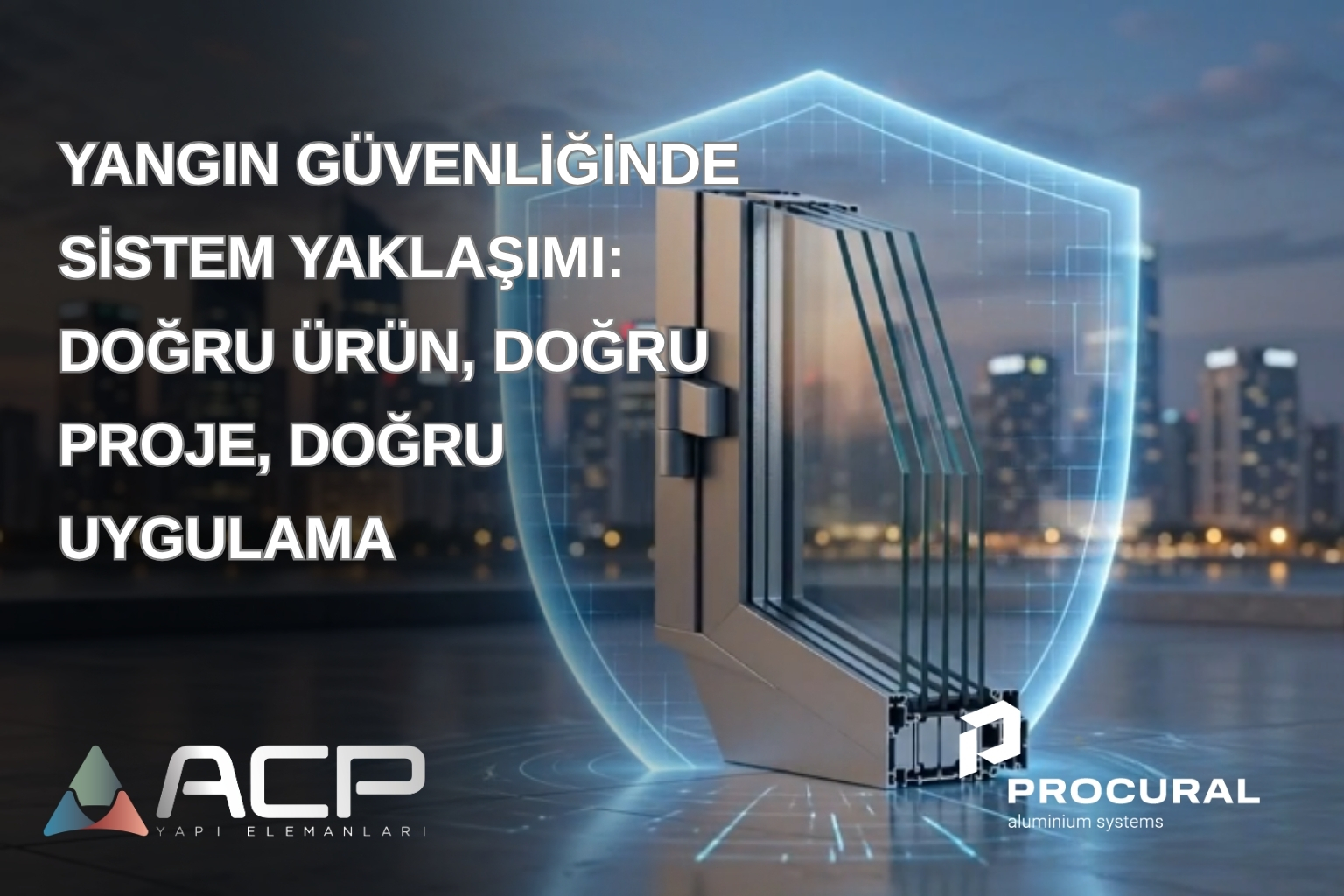
System Approach in Fire Safety | The Right Product and Application
System Approach in Fire Safety | The Right Product and Application
System Approach in Fire Safety: The Right Product, The Right Project, The Right Application
Fire safety in buildings is not a matter that can be achieved solely by choosing a specific product. For a safe structure, it is necessary to choose the right product, analyze the needs of the project correctly, and implement the application in accordance with the technical requirements.
Especially while glazed partitions, aluminum systems, automatic doors and different access solutions used in modern buildings have become important parts of architectural design, they should also be evaluated correctly in terms of fire safety.
Therefore, in fire-resistant systems, what truly matters is not just “which product?”” it is not to answer the question; “for which project, at what performance level and how should it be implemented?” to evaluate their questions together.
Why Does Fire Safety Require a Systems Approach?
The fire safety of a structure cannot be considered independently of the performance of a single component. The performance of a fire-resistant solution depends on the compatibility of the profile, glass, fasteners, accessories, and application details.
Therefore, when evaluating fire-resistant systems, simply looking at the product’s technical specifications is not sufficient.
Profile + glass + accessory + connection details + application = system performance
This approach becomes even more important in projects requiring high security, such as hospitals, hotels, airports, public buildings, commercial buildings, and industrial facilities.
The Right Product: Performance Tailored to Needs
The fire safety requirements for every structure are not the same. Many factors such as the building’s intended use, the location of fire compartments, escape routes, and architectural design can be decisive in system selection.
When evaluating fire resistance, performance classes E, EW, and EI should be taken into account.
Class E – Integrity
Refers to preventing the passage of flames and hot gases during a fire.
EW Class – Integrity + Radiant
In addition to integrity, it refers to the limitation of heat radiation generated during a fire.
EI Class – Integrity + Insulation
It refers to the limitation of heat transfer in addition to thermal insulation.
Therefore, instead of choosing only from the expression ”fire resistant”, it is necessary to correctly determine the performance class and durability period required by the project.
The Right Project: Fire Safety Begins at the Design Phase
Fire safety is often overlooked when it comes to considering it during the implementation phase.
The correct approach is to evaluate fire-resistant systems in the early stages of the architectural and technical design process.
During the project phase;
Fire compartments
Escape routes
Doors and access points
Glazed partitions
Aluminum joinery systems
Accessories to be used
The integration details of the systems
must be considered as a whole.
Thus, it is possible not only to meet the technical requirements, but also to carry out the architectural design and security needs in a balanced manner.
Correct Implementation: The Determining Factor of System Performance
Even selecting the most suitable product does not guarantee the expected performance on its own in a project where the implementation is not carried out correctly.
In fire-resistant aluminum systems, the size, connection points, connections, installation details and compliance of the components used with the system requirements are of great importance.
During the implementation process, technical documentation must be taken into account and the system must be installed in accordance with the application principles defined by the manufacturer.
In fire safety, the quality of implementation is as important as the product itself.
A Holistic Approach to Fire-Resistant Aluminum Systems
Aluminum systems are widely used in modern structures due to their advantages such as aesthetics, durability, and design flexibility.
However, in applications where fire resistance is required, standard aluminum systems and fire-resistant systems should not be evaluated in the same way.
All components used in fire-resistant aluminum systems must work together to contribute to the targeted performance.
At this point, choosing system solutions that have been tested and whose performance has been verified is an important criterion for project security.
Looking at the Entire Solution, Not Just the Product
Making the right decision in the field of fire safety requires more than just selecting a product from a catalog.
It is necessary to analyze the needs of the project, determine the appropriate performance level, evaluate the compatibility of the system components and implement the application correctly.
Therefore, the approach to fire safety in the construction sector should be evaluated under the following three main headings:
Right Product → Right Project → Right Implementation
The harmonious progression of these three phases plays a critical role in ensuring the performance expected from fire-resistant systems.
Safe Structures Begin with the Right Decisions
Fire safety is not an afterthought added to a structure; it is one of the fundamental elements of the design and construction process.
In order to create safe and sustainable structures, it is necessary to go beyond product selection; to understand the needs of the project correctly and to develop fire-resistant system solutions suitable for these needs.
As ACP Construction Elements, we care not only about offering products in construction technologies, but also about being a solution partner that analyzes the needs of the project, contributes to the determination of the correct system and evaluates the application process from a technical point of view.
Because for us, fire safety is much more than the performance of a single product.
The right product. The right project. Correct application.
Holistic solution approach for safe structures.
Frequently Asked Questions
What is a fire-resistant system?
Fire-resistant systems are systems designed to meet performance criteria such as integrity, thermal insulation or radiation limitation for a certain period of time during a fire.
What should be considered when choosing a fire-resistant system?
In the selection of the system, the purpose of use of the structure, fire compartments, the required resistance time, the performance class, the compatibility of the components used and the application details should be evaluated together.
What do EI30, EI60, EI90, and EI120 mean?
These classifications indicate that the system meets the relevant fire performance criteria for specified periods of time. For example, EI60 indicates that the relevant performance must be maintained for 60 minutes.
Can aluminum systems be fire-resistant?
Yes Aluminum systems specifically designed for fire resistance and whose performance has been verified through tests can be used to meet the fire safety requirements of projects.
Why is application important in fire-resistant systems?
Because the performance of the product depends not only on the properties of the material, but also on the correct use of the system components and the implementation of the application in accordance with the technical details determined by the manufacturer.
Email & Phone
info@acpyapi.com.tr
+90 (312) 348 68 68
+90 (533) 230 21 61